May 11, 2026
Key Takeaways:
- Identify Winter Burn: Check evergreens and broadleaf trees for browning or burnt foliage caused by harsh Michigan winds.
- Inspect the Trunk Flare: Look for frost cracks or vertical splits in the bark, which are common after dramatic temperature swings in Oakland County.
- Spot Hidden Hazards: Identify hanging limbs or widow makers that may have been broken by heavy snow loads but haven’t fallen yet.
- Monitor Bud Development: Delayed or patchy budding can signal root stress or disease such as Oak Wilt or Dutch Elm Disease.
- Evaluate Soil and Mulch: Ensure that winter salt runoff hasn’t contaminated the root zone and that mulch is not piled against the trunk.
There is a certain undeniable magic when the snow finally retreats from the rolling hills of Farmington Hills and the quiet streets of Livonia. We see the first robins and immediately our thoughts turn to the lawn, the mulch, and perhaps the patio furniture. But if you really stop to look up, you will realize that your trees have just survived a grueling, relentless marathon.
In Southeast Michigan, winter isn’t just a season; it is a structural test. Between the heavy wet snows that weigh down our White Pines and the polar vortex snaps that send temperatures plummeting in Howell, our trees endure a lot. Spring is the critical window, the golden hour to perform a thorough inspection because once the canopy fills in with leaves, many structural defects and diseases become invisible to the naked eye.
The Ground Up Approach: Root Flares and Soil
One should always start, surprisingly enough, at the bottom. The area where the trunk meets the soil, known as the root flare, is the brain of the tree’s structural system. During a Michigan winter, we use a staggering amount of salt to keep our driveways in Novi and Southfield safe. Unfortunately, that salt often washes directly into the root zone.
If you notice a white crusty residue on the soil or if the grass at the base of your tree looks particularly scorched, your tree may be suffering from salt toxicity. Furthermore, you must look for volcano mulching that common yet disastrous practice where mulch is piled high against the bark. In the spring, this traps moisture and creates a haven for fungi and rodents, which can girdle the tree before the summer even begins. It is advisable to ensure the flare is visible and clear of debris.
Reading the Bark: Cracks, Cankers, and Critters
As you move your eyes up the trunk, you are looking for the tree’s skin to tell you its history. Southeast Michigan is notorious for sunscald or frost cracks. These are long vertical splits that occur on the south or southwest side of the tree, usually on younger Maples or Willows. This happens when the winter sun warms the bark during the day, but the temperature drops instantly at sunset, causing the tissue to rupture.
While a small crack might heal, a deep split is an open door for pests. You should also keep a sharp eye out for cankers, depressed, discolored areas of bark that look like unhealed wounds. In our region, these are often signs of fungal infections that can cut off the flow of nutrients. And let’s not forget the sawdust or tiny holes that signal the arrival of borers. If your Ash trees are still standing, spring is when the Emerald Ash Borer signs become most evident, often through increased woodpecker activity as they hunt for the larvae hidden beneath the bark.
The Skeleton in the Canopy: Identifying Structural Risks
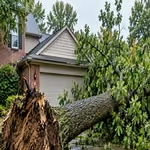
Before the leaves unfurl and hide the architecture of the branches, you must look for the hangers. These are limbs that have snapped under the weight of an ice storm common in places like Bloomfield Hills, but are currently caught in the lower canopy. These are literal widow makers waiting for a spring thunderstorm to send them crashing down onto a roof or a parked car.
Look for V-shaped crotches where two main trunks compete for dominance. In the tree world, V stands for vulnerability. These narrow attachments are prone to splitting, especially when the heavy spring rains add weight to the foliage. If you see a crack starting at that junction, the tree is a ticking time bomb. It is quite simply a matter of physics, the leverage of the wind against a weakened joint.
The Budding Truth: What Delayed Growth Means
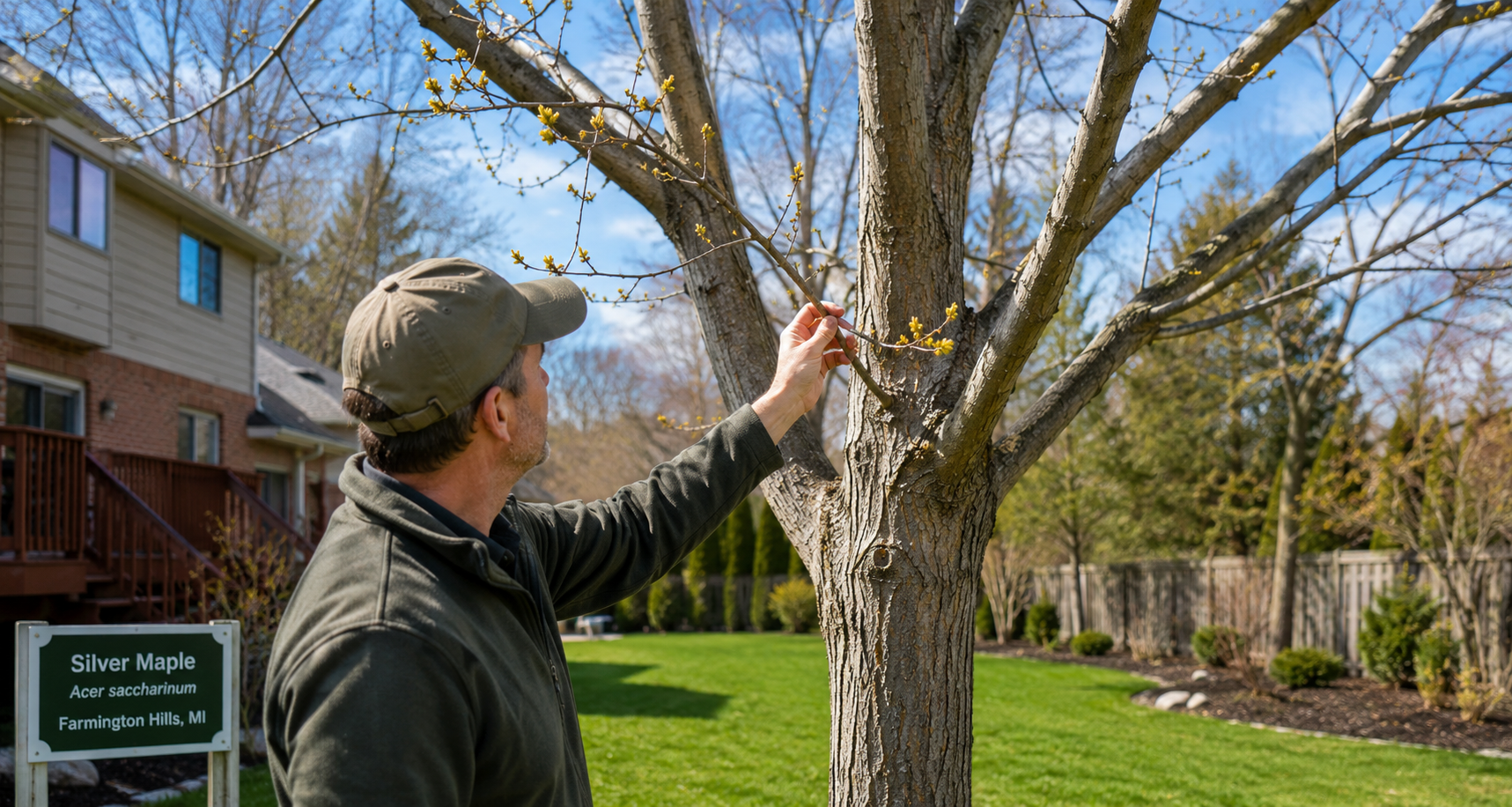
Timing is everything. In Southeast Michigan, we expect our Silver Maples to bud early, followed by the Oaks and Elms. If you notice a tree in your yard, perhaps that massive Oak in your Northville backyard is lagging behind its neighbors, do not ignore it.
Delayed budding or dieback, where the tips of the branches remain bare while the rest of the tree is green, is a cry for help. It often points to root rot from a saturated spring soil or, more seriously, vascular wilts. In our area, Oak Wilt is a devastating reality. Spring is the only time to catch these symptoms early enough to intervene. If the leaves emerge and immediately look wilted or scorched on the edges, you are likely looking at a moisture transport issue that requires an expert’s eye.
Evergreens and the Winter Burn
We love our Arborvitae and Hemlocks for the privacy they provide in Royal Oak and Birmingham, but they often come out of winter looking a bit rusty. This winter burn happens when the needles lose moisture to the wind while the ground is still frozen, preventing the roots from replacing that water.
While some browning is normal if the interior of the tree is brittle and the buds at the tips are dry and crumbly, the tree may not recover. Spring is the time to decide if these shrubs can be saved with deep root feeding and specialized pruning or if they have become an eyesore that needs to be removed to make way for healthier specimens.
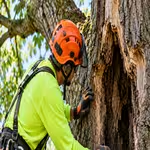
When your spring inspection reveals concerns, whether it’s a hanging limb over your Plymouth garage or a suspicious crack in a Howell oak, you need a team that blends experience with a neighborly touch. Clean Cut Tree Experts has been a cornerstone of Southeast Michigan since 2010, though our family-owned roots go back over 25 years. We aren’t just a crew with a chainsaw; we are a full-service partner dedicated to making strong, beautiful trees attainable for everyone in Farmington Hills, Livonia, and Novi. From crane-assisted removals of massive hazardous trees to precision pruning that promotes long-term health, our licensed and fully insured teams handle it all with competitive pricing. We treat your property with the same respect we’d show our own, leaving no mess behind and offering senior discounts and zero money upfront insurance billing to keep the process stress-free.
Whether you need a 24/7 emergency response after a spring storm or a holistic consultation to save a struggling landmark, trust the experts who know the unique soil and climate of Oakland and Livingston counties. Let us help you keep your Michigan landscape safe, vibrant, and Clean Cut for the seasons ahead.
Frequently Asked Questions by Homeowners in Southeast Michigan
Is it safe to prune my trees in the spring in Southeast Michigan?
It depends entirely on the species. For most deciduous trees, dormant pruning in late winter or very early spring is ideal. However, you should never prune Oaks between April and July in Michigan due to the high risk of Oak Wilt, as the sap-feeding beetles that carry the fungus are most active then.
What should I do if my tree has a large vertical crack after winter?
Small frost cracks often close on their own as the tree grows, but a deep split that exposes the inner wood is a serious structural risk. It is advisable to have an expert assess if cabling and bracing can save the tree or if the damage has compromised its integrity beyond repair.
Why are the pine needles on my trees turning brown in May in Southeast Michigan?
This is often winter burn or a fungal needle cast disease. Because Michigan springs are often wet and cool, fungi thrive. A professional can determine if the tree needs a specialized fungicide treatment or if supplemental watering will help it recover.
Do I need a permit to remove a tree in Farmington Hills or West Bloomfield?
Many communities in Southeast Michigan, especially West Bloomfield and Franklin, have specific tree ordinances and landmark tree protections. Clean Cut Tree Experts can help you navigate these local rules to ensure your removal is fully compliant.
How can I tell if a dead branch is actually dead?
The scratch test is a simple trick. Use your fingernail to scratch a small bit of bark off a twig. If it’s green and moist underneath, there is still life. If it is brown, brittle, and snaps easily, that branch is likely dead and should be removed before it falls.
What is crane-assisted tree removal, and why is it used?
For trees in tight spots like between two houses in Birmingham, a crane allows us to lift large sections vertically and away from your property. This is the safest method for removing hazardous trees without damaging your roof, lawn, or landscaping.
Does Clean Cut Tree Experts offer stump grinding?
Yes. We don’t just cut the tree; we can grind the stump well below ground level. This prevents pests like ants and termites from moving in and allows you to replant or lay sod over the area immediately.
What is the Pay It Forward discount?
We believe in supporting those who serve our community. We offer special discounts for seniors, teachers, first responders, and military members to ensure professional tree care is accessible to those who give so much to Southeast Michigan.
Summary Checklist: Spring Tree Inspection
| Feature | Condition | Recommended Action |
|---|---|---|
| Root Flare | Covered by mulch or dirt | Clear away debris until the flare is visible |
| Trunk Bark | Vertical splits or sunscald | Monitor for healing; consult an expert if deep |
| Branches | Broken limbs hanging in the canopy | Schedule a professional removal immediately |
| Buds | No buds or patchy growth | Check for root stress or disease symptoms |
| Evergreens | Brittle brown needles | Apply deep root fertilization and prune dead tips |
Final Advice
A meticulous property walkthrough should be conducted as soon as the frost leaves the soil to identify structural defects before the heavy spring thunderstorms arrive. To ensure the safety of your structures, prioritizing the removal of large hanging limbs and widow makers remains a critical necessity for every homeowner. Attention should be paid to any vertical bark splitting or oozing cankers, which often signal deep physiological stress or pathogen entry that requires immediate professional assessment.
Please avoid invasive pruning of Oak and Elm species during the active spring growth window to minimize the risk of attracting disease-carrying insects. Supplemental irrigation is viewed as a strategic necessity if the Michigan spring proves unusually dry, as newly emerging buds have an intense demand for hydration. Consideration should be given to the soil chemistry near driveways where salt accumulation may have occurred, as this can lead to root toxicity and long-term canopy decline. Consulting with a qualified specialist allows for the early detection of borer activity and fungal needle cast that could otherwise lead to tree failure by midsummer. Maintaining a clear and visible root flare by removing excessive mulch remains one of the simplest and most effective ways to prevent trunk rot and pest infestation. Ultimately, implementing a proactive spring inspection routine is the most cost-effective way to preserve the aesthetic value and structural integrity of your landscape.