April 11, 2026
The Emerald Ash Borer (EAB) poses an invisible but devastating threat to ash trees across Southeast Michigan, silently transforming them from majestic landscape features into extreme hazards. Since it arrived in 2002, this invasive beetle has left a trail of destruction, making countless ash trees brittle, unstable, and prone to catastrophic failure. Understanding the signs and acting decisively is crucial for protecting your property and ensuring safety in our local communities.
Key Takeaways
- The Emerald Ash Borer has killed tens of millions of ash trees across the state. According to the Michigan Department of Natural Resources (DNR), homeowners no longer need to report sightings to the state, as the focus has shifted entirely to the removal and management of high-risk trees
- EAB larvae feed on the inner bark, disrupting water and nutrient flow, leading to structural weakness and tree death within 2-4 years.
- Infested ash trees become severe hazards, prone to falling branches or entire trees, threatening homes, property, and personal safety.
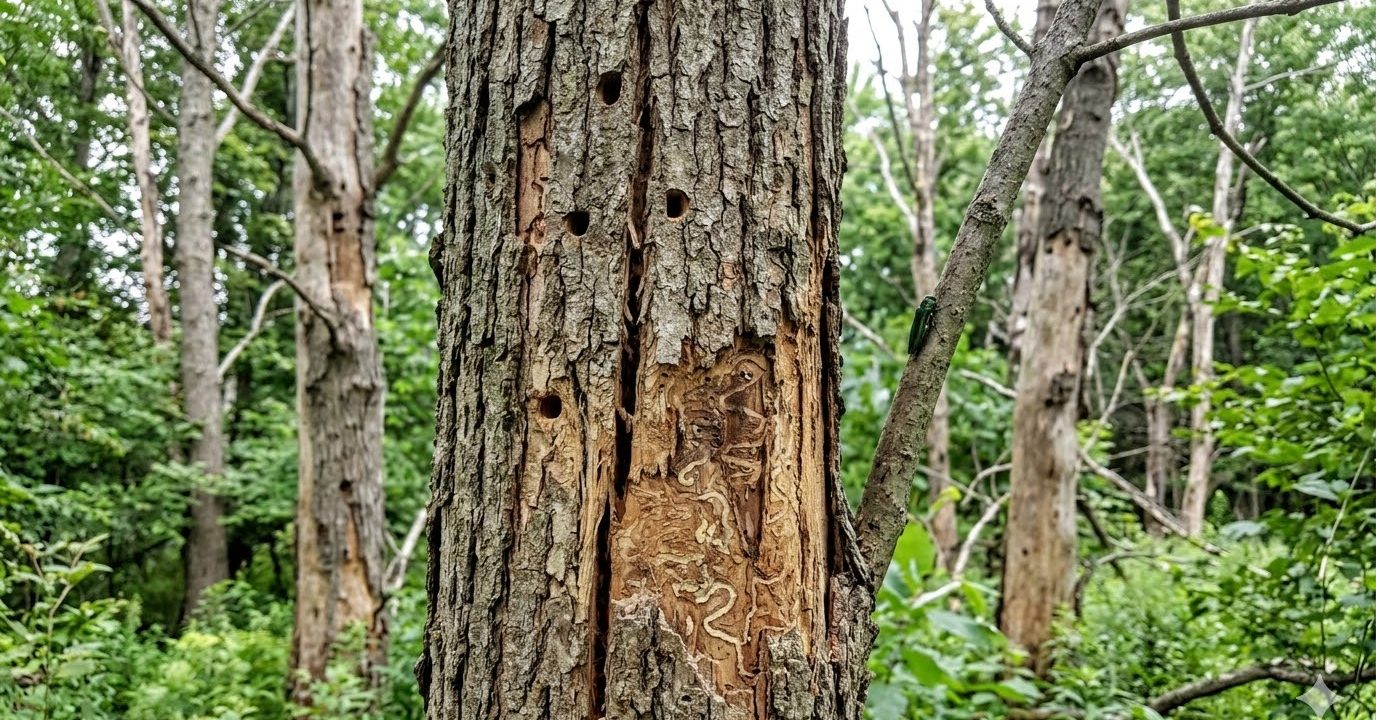
- Key signs of EAB include D-shaped exit holes, S-shaped tunnels under bark, bark splitting, and canopy thinning.
- Homeowners must consider either preventative chemical treatments (for healthy trees) or professional removal of infested or declining ash trees.
- Local regulations for tree removal vary by municipality in Southeast Michigan; always check permit requirements before proceeding.
What is the Emerald Ash Borer (EAB), and why is it in Michigan?
The Emerald Ash Borer (EAB), Agrilus planipennis, is a highly destructive invasive beetle from Asia that targets all species of ash trees. It was first identified in Southeast Michigan in 2002, and its presence has since reshaped the region’s landscape. The beetle’s life cycle is insidious, with the most damage occurring during its larval stage.
- Origin: Native to Northeastern Asia, EAB was likely introduced to North America via wood packing materials.
- Discovery: First detected near Detroit, Michigan, in June 2002, the beetle quickly spread due to a lack of natural predators and host resistance.
- Life Cycle: Adult beetles emerge in late spring, feed on ash leaves, and lay eggs on the bark. Larvae hatch and bore into the tree, creating distinctive S-shaped tunnels.
- Target: EAB exclusively attacks ash trees (genus Fraxinus), including green, white, black, and blue ash species common in Michigan.
The Unseen Threat: How EAB Weakens Ash Trees from Within
EAB doesn’t just kill ash trees; it systematically weakens them from the inside out, turning them into ticking time bombs. The larvae feed voraciously on the phloem, the critical tissue responsible for transporting sugars and nutrients from the leaves to the roots. This feeding creates a network of tunnels that effectively girdles the tree.
Recognizing the Signs of EAB Infestation
Identifying an EAB infestation early is crucial, though often challenging, as initial damage occurs internally. Look for these specific indicators:
- D-shaped Exit Holes: Small (1/8-inch) D-shaped holes on the bark where adult beetles emerge.
- S-shaped Galleries: Serpentine tunnels under the bark, visible when bark peels or is removed.
- Vertical Bark Splitting: The tree’s attempt to heal over larval tunnels can cause bark to split vertically.
- Thinning Canopy: Progressive dieback of branches, starting from the top, leading to a sparse crown.
- Epicormic Sprouting: Clusters of new shoots growing from the trunk or base of the tree, a stress response.
- Increased Woodpecker Activity: Woodpeckers feed on EAB larvae, so their increased presence can signal an infestation.
The Timeline of EAB Damage
The progression from infestation to a hazardous tree can be surprisingly rapid. Once infested, an ash tree typically has a limited lifespan.
- Year 1-2: Infestation begins, often with no visible external symptoms or only minor canopy thinning. Larvae are actively feeding.
- Year 2-3: Canopy thinning becomes more noticeable (30-50% dieback), D-shaped holes may appear, and bark splitting can start. The tree’s structural integrity begins to be compromised.
- Year 3-4: Severe canopy dieback (50% or more), extensive bark splitting, and visible exit holes are common. The tree is severely weakened, brittle, and highly prone to failure. Most trees die within this timeframe.
- Year 4+: The tree is typically dead. Dead ash trees become extremely brittle very quickly, posing significant risks during storms or even calm conditions.
Why EAB-Infested Ash Trees are Extreme Hazards in Southeast Michigan
The widespread death of ash trees due to EAB has created a unique and pressing safety issue across Southeast Michigan. Dead and dying ash trees don’t just look bad; they are inherently dangerous, especially in our densely populated urban and suburban environments.
Risks to Property and Safety
The structural failure of EAB-infested ash trees poses direct threats to homes, vehicles, and people.
- Falling Branches: Dead limbs can break off without warning, causing damage to roofs, cars, and fences.
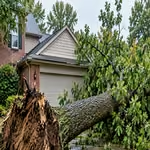
- Full Tree Failure: Entire trees, especially large ones, can topple during high winds or even under their own weight as wood decays, leading to catastrophic property damage or severe injury.
- Power Line Hazards: Trees falling into power lines can cause outages, electrical fires, and create electrocution risks.
- Increased Insurance Claims: Property damage from falling trees often leads to costly insurance claims and deductibles for homeowners.
- Obstruction of Public Ways: Trees falling across roads or sidewalks create immediate hazards for commuters and pedestrians.
Understanding Local Impact: Southeast Michigan’s EAB History
Southeast Michigan has been at the epicenter of the EAB crisis, offering a stark lesson in the beetle’s destructive power. The region’s experience serves as a critical warning for homeowners.
- Ground Zero: EAB was first discovered in Southeast Michigan and Windsor, Ontario, in 2002.
- Rapid Devastation: By 2004, an estimated 10-15 million ash trees in urban and suburban areas of Southeast Michigan had died. This number grew to over 20 million by 2006.
- Widespread Loss: Estimates suggest that 80% to 99% of mature ash trees in the core infestation zone, including Detroit and surrounding communities, were wiped out.
- Continuing Threat: Even with many ash trees gone, scattered survivors and younger trees remain vulnerable, requiring ongoing vigilance and management.
Mitigation Strategies: Protecting Your Ash Trees or Removing Them Safely
When faced with EAB, homeowners have two primary courses of action: treatment to protect healthy trees or removal of infested and hazardous ones. Making the right decision depends on the tree’s health, infestation level, and your budget.
| Feature | EAB Treatment | Ash Tree Removal |
| Purpose | Protect healthy ash trees | Remove hazardous or dying trees |
| Best For | Trees with less than 30% canopy dieback | Heavily infested, declining, or dead ash trees |
| Cost | $75 to $250 per tree annually | $800 to $3,000 average for mature ash trees |
| Risk | Requires ongoing treatment to remain effective | Eliminates the hazard immediately |
EAB Treatment Options: When Are They Effective?
Chemical treatments can protect ash trees from EAB, but they are not a universal solution. They are most effective as a preventative measure or for trees in the very early stages of infestation.
- Systemic Insecticides: Applied as soil drench, trunk injection, or basal bark spray, these chemicals are absorbed by the tree to kill EAB larvae.
- Timing is Key: Treatments typically need to be applied every 1-3 years, depending on the product, usually in spring or early fall.
- Tree Health: Only healthy ash trees with less than 30% canopy dieback are good candidates for treatment. Severely infested trees are unlikely to recover.
- Cost-Benefit: Consider the long-term cost of repeated treatments versus the cost of removal and replacement. For a few high-value trees, treatment might be viable.
Ash Tree Removal: The Safe and Necessary Solution
For trees that are already significantly infested, declining, or dead, professional ash tree removal is the safest and often only practical solution. Attempting DIY removal of a hazardous ash tree is extremely dangerous.
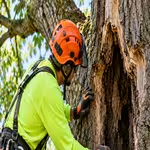
- Safety First: Professional tree removal crews have the training, equipment, and insurance to safely remove large, unstable trees, especially those near structures or power lines.
- Preventative Removal: Removing at-risk ash trees before they become critically hazardous can prevent costly property damage or injuries.
- Stump Grinding: After removal, stump grinding eliminates the tripping hazard and allows for replanting or landscaping.
- Emergency Services: For trees that have already failed or are an immediate threat, Clean Cut Tree Experts offers prompt emergency tree services to mitigate danger.
The Cost of EAB: Understanding Financial Implications for Southeast Michigan Homeowners
The financial implications of EAB can be significant for homeowners. While the initial cost of removal might seem high, it pales in comparison to the potential expenses of property damage or injury caused by a falling tree.
Factors Influencing Ash Tree Removal Costs
Several factors influence the overall cost of ash tree removal in Southeast Michigan. For mature ash trees, homeowners can generally expect costs to range from $800 to $3,000, although this can vary significantly. Understanding these helps you anticipate expenses.
- Tree Size: Taller and wider trees require more labor, equipment, and time, increasing costs significantly.
- Tree Location: Trees close to structures, power lines, fences, or other obstacles are more complex and costly to remove due to safety precautions.
- Tree Condition: Dead or severely compromised trees are more brittle and unpredictable, requiring extra care and potentially specialized equipment, which drives up the price.
- Accessibility: Trees in hard-to-reach backyards, or those requiring cranes, will incur higher costs than easily accessible trees.
- Stump Grinding: This is often an additional service, removing the stump below ground level.
- Debris Removal: Hauling away wood chips and logs is usually included, but confirm with your provider.
The True Cost of Doing Nothing
Delaying necessary tree removal can lead to far greater expenses and risks down the line. What might seem like saving money can quickly become a financial nightmare.
- Property Damage: A fallen ash tree can destroy roofs, fences, decks, sheds, or vehicles, leading to thousands in repair costs and increased insurance premiums.
- Personal Injury: The most severe consequence of a falling tree or limb is serious injury or even fatality to residents or passersby.
- Higher Removal Costs: Waiting until a tree is dead and severely brittle makes removal more dangerous and complex, often increasing the price due to the heightened risk and specialized equipment needed.
- Liability: If your hazardous tree causes damage or injury to a neighbor’s property or a public area, you could be held liable.
Navigating Local Regulations for Ash Tree Removal in Southeast Michigan
Navigating local regulations for tree removal can be confusing, as rules vary significantly between municipalities in Southeast Michigan. Always check with your local city or township before proceeding with any tree removal.
- Public vs. Private Property: Trees on public land (e.g., between the sidewalk and street) almost always require municipal permits.
- Protected Trees: Some communities have ordinances protecting certain species or large, mature trees, regardless of health.
- Consequences of Non-Compliance: Removing a tree without a required permit can result in fines, penalties, or even orders to replace the tree at your expense.
Permit Requirements by Municipality
While general guidelines exist, specific permit requirements depend heavily on your exact location. Here’s what homeowners in some Southeast Michigan communities might encounter:
- Novi, MI: Strict regulations apply in neighboring communities; Northville requires a permit for any tree removal eight (8) inches DBH or larger, while Novi requires a permit for any work on public right-of-way trees or significant removals on private lots.
- Howell, MI: Generally, no permit is needed unless the tree is in a public easement or subject to specific zoning rules. Homeowner Associations (HOAs) may have their own stricter rules.
- Southfield, MI: Permits are often required for large or protected trees, trees in the public right-of-way, or for construction-related removals. However, permits may be waived for dead or hazardous trees posing immediate danger, or for ash trees affected by EAB.
- Canton Township: Requires permits for trees with a 6-inch DBH or greater.
- Northville: Regulates the removal of trees 8 inches in diameter or greater.
- General Rule: Always confirm with your specific city or county planning/public works department, especially for trees near property lines or public spaces.
Frequently Asked Questions
How quickly do Emerald Ash Borers kill ash trees?
Ash trees infested with EAB typically die within 2-4 years of initial infestation. The larvae disrupt the tree’s vascular system, preventing water and nutrient transport. This structural compromise makes the tree increasingly brittle and prone to failure, especially in storms, creating significant hazards.
What are the key signs of an Emerald Ash Borer infestation?
Common signs include D-shaped exit holes (about 1/8 inch wide) on the bark, S-shaped tunnels (galleries) under the bark, vertical bark splitting, thinning canopy, epicormic sprouting (suckers) from the trunk or roots, and increased woodpecker activity.
Is it better to treat an ash tree or remove it?
Treatment is most effective on healthy ash trees with less than 30% canopy dieback. It’s a preventative measure, not a cure for severely infested or declining trees. Treatments need to be applied by a licensed arborist every 1-3 years, depending on the product, and can be costly over the tree’s lifespan.
Do I need a permit to remove an ash tree in Southeast Michigan?
Permit requirements vary greatly by city and county in Southeast Michigan. Generally, you’ll need a permit for trees on public property, in the public right-of-way, or for large/protected trees on private land. Always check with your local municipal office before removing any tree.
What should I look for in a professional tree removal service?
When choosing a tree service, look for companies that are licensed and insured, have licensed arborists on staff, offer transparent pricing, provide clear communication, and have a strong local reputation for safety and thorough cleanup. Always get multiple estimates.
Protecting Your Property From Emerald Ash Borer Damage
The Emerald Ash Borer presents a severe and ongoing threat to ash trees across Southeast Michigan, transforming once healthy trees into dangerous liabilities. Understanding the signs of infestation, the progression of damage, and the critical need for timely intervention protects your property and loved ones. Whether you’re considering treatment or need removal, partnering with experienced local professionals like Clean Cut Tree Experts ensures the job is done safely, effectively, and in compliance with local guidelines. Don’t wait for a hazardous tree to become a disaster; Contact Us today for expert assessment and solutions.