Expert Advice for Michigan Homeowners from Clean Cut Tree Experts
April 2, 2026
Whether it’s the sudden violence of a summer thunderstorm or the quiet, creeping spread of a fungal infection, Michigan trees face constant challenges. For a homeowner, the sight of a damaged or declining tree brings a difficult question: Can pruning save it, or is it already too late?
This guide explores the dual threats of storm damage and disease, helping you identify when a tree can be restored to health and when it poses a structural risk to your home.
Part 1: Assessing the Damage – Storms vs. Disease
The Sudden Impact: Storm Damage
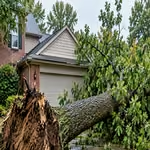
Storms in Southeast Michigan—from high winds and lightning to heavy ice—can turn a healthy landscape into a disaster zone overnight. Before deciding to cut a tree down, look for these key signs:
- Broken or hanging “widowmaker” limbs.
- Cracked or split main trunks.
- Uprooted bases or soil “heaving.”
- Damage to more than 25% of the canopy.
As the University of Missouri Extension notes, trees can often survive significant canopy loss, but once the main trunk or root system is compromised, recovery becomes unlikely.
The Slow Decline: Disease and Pests
When a tree declines gradually, most homeowners notice something small at first: a few dead branches, missing bark, or thinning leaves that change color prematurely. Most problems fall into these categories:
- Disease: Bacterial and fungal infections are common in Michigan’s humid climate (Oak Wilt, Anthracnose, Dutch Elm Disease).
- Insects: Pests like the Emerald Ash Borer, scale insects, or aphids weaken the tree from the inside.
- Environmental Stress: Michigan’s freeze-thaw cycles, droughts, or root compaction from nearby construction.
- Age and Neglect: Small wounds that were never addressed are turning into deep rot or systemic decay.
Part 2: How Pruning Helps a Struggling Tree
Pruning is more than an aesthetic choice; it is a surgical intervention. When done correctly, it can actively help a tree fight disease and recover from damage by:
- Removing Infected Wood: Preventing the spread of pathogens to healthy tissue.
- Improving Airflow & Sunlight: Reducing humidity inside the canopy, which slows fungal growth.
- Reducing Physical Stress: Removing heavy or dead branches to allow the tree to focus energy on healing the trunk and roots.
- Encouraging Regrowth: Strategic pruning triggers new, healthy shoots to replace lost limbs.
At Clean Cut Tree Experts, we use “restorative pruning” to stabilize trees. This involves clean cuts just outside the branch collar, allowing for natural healing through the CODIT model (Compartmentalization of Decay in Trees).
When Pruning Can Save the Tree
Pruning is likely to work if:
- The infection is limited to specific branches, not the trunk or roots.
- Less than 30% of the canopy is affected.
- The tree still produces new leaves and buds each season.
- The bark remains mostly intact, with only a few deep vertical cracks.
- The root system feels solid and undisturbed in the ground.
Part 3: When Removal is the Only Safe Option
Sometimes, pruning is just delaying the inevitable. A tree becomes a liability when its internal structure can no longer support its weight. Removal is necessary when:
- The trunk is decaying, hollow, or oozing sap.
- The bark is falling off in large sections.
- The canopy has lost more than half its leaves.
- Mushrooms or “conks” are growing at the base (indicating root rot).
- The tree leans significantly toward a home, road, or power line.
- Insects have hollowed out the structural wood.
Part 4: Common Michigan Threats
Specific Diseases to Watch For
- Oak Wilt: Spreads by beetles or root grafts. Important: Never prune oaks during the growing season (spring to midsummer); prune only in late fall or winter.
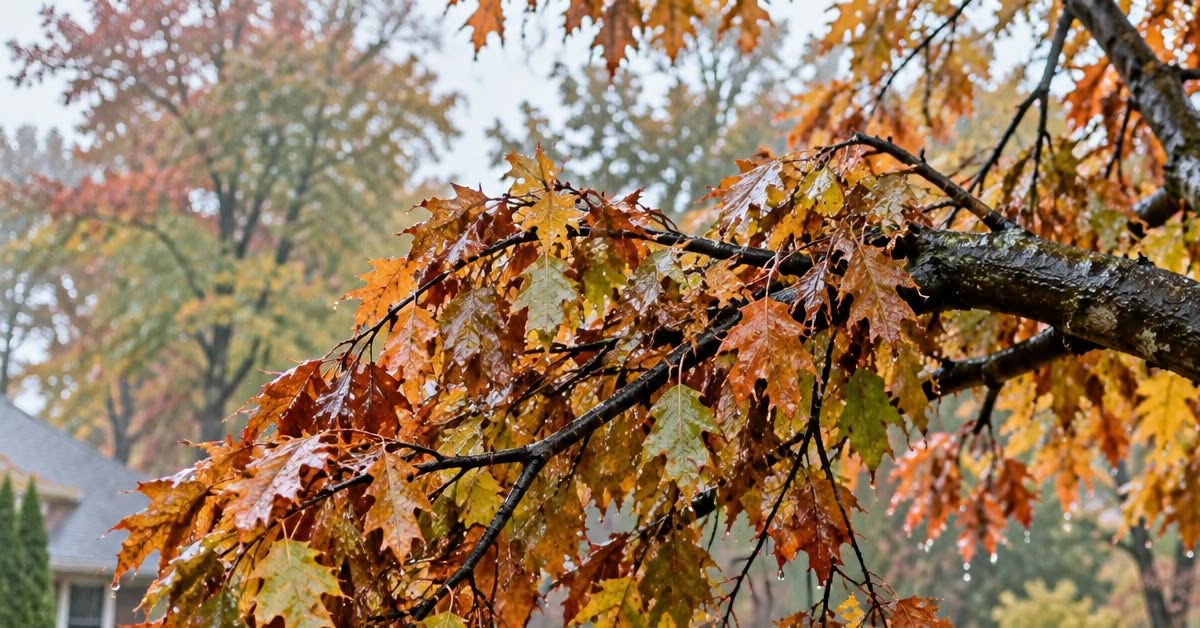
- Anthracnose: Fungal infection after cool, wet Michigan springs; causes brown leaf tips and twig dieback.
- Dutch Elm Disease: A systemic fungus carried by bark beetles that yellows leaves from the top down.
- Fire Blight: Common in ornamental pears and apples; shoots look blackened or “burned.”
- Canker Diseases: Sunken lesions or cracks on branches; requires pruning back to healthy wood.
Specific Weather Damage
- Wind: Snaps brittle species like Silver Maples or Willows.
- Ice: Adds thousands of pounds of weight to evergreens, causing sudden breaks.
- Soil Saturation: Loosens the grip of shallow-rooted trees like Spruce or Pine.
Part 5: The Cost and Insurance Factor
Pruning is generally a fraction of the cost of removal. However, waiting until a tree falls can lead to catastrophic expenses.
- Maintenance Costs: Minor pruning ranges from $200 to $750; large removals often exceed $1,000.
- Insurance Coverage: According to the Insurance Information Institute, homeowners’ insurance typically covers removal only if the tree hits a covered structure (house, fence, garage). If a tree falls in the yard without hitting anything, the cleanup cost is often the homeowner’s responsibility.
- Neglect Warning: Claims can be denied if an insurer proves the tree was dead or diseased and the homeowner failed to mitigate the known hazard.
Part 6: Professional Care vs. DIY
After a storm or a diagnosis of a disease, it is tempting to handle the situation yourself. However, storm-damaged and diseased trees are highly unpredictable.
- Tension: Branches under pressure can “spring” when cut, causing fatal injuries.
- Sanitation: Professionals sterilize tools between every single cut to prevent spreading bacteria (like Fire Blight) from one limb to another.
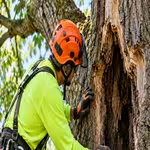
- Precision: Arborists identify the exact “branch collar” to ensure the tree can heal rather than leaving “stubs” that invite rot.
Success Stories: Bringing Michigan Trees Back to Life
- Birmingham Maple: A homeowner noticed bark cracking (canker). Our crew pruned infected limbs and sanitized the wounds; the tree recovered within two seasons.
- Bloomfield Hills Oak: Pruned during dormancy to avoid Oak Wilt. The tree stabilized and remains healthy three years later.
- Livonia Ash: While many were lost to Borer, we saved several through selective pruning and root aeration to boost their natural immunity.
Frequently Asked Questions
How do I know if my tree can be saved?
If the trunk is solid and the damage/disease is limited to less than 25-30% of the branches, pruning is usually successful. If the trunk is split or decaying at the base, it’s likely too late.
Can a tree recover from root damage?
Pruning the top can reduce the energy demand on a weakened root system, but it cannot “fix” roots. If roots are uprooted or severed by construction, the tree usually declines over 1–2 years.
Is pruning cheaper than removal?
Yes, preventative pruning is significantly cheaper than emergency removal or repairing roof damage caused by a fallen limb.
Does insurance cover disease-related removal?
Usually no. Insurance covers “sudden and accidental” events like wind. Disease is considered a maintenance issue that the homeowner must address proactively.
Ready for an Expert Assessment?
Don’t wait for a storm to decide for you. Whether your tree is leaning, losing leaves, or has broken limbs, Clean Cut Tree Experts provides honest evaluations and professional care across Metro Detroit.
Our Services Include:
- 24/7 Emergency Storm Response
- Crane-Assisted Removals for Hazardous Trees
- Precision Pruning & Disease Management
- Stump Grinding & Site Cleanup
Clean Cut Tree Experts 📍 30660 W 8 Mile Rd, Farmington Hills, MI 48336 📞 (734) 290-3370
Serving Farmington Hills, Birmingham, Bloomfield Hills, Novi, Livonia, and surrounding communities.