July 21, 2026
Quick Answer: A girdling root grows across or around a tree’s trunk instead of away from it, slowly crushing the tissue that moves water and nutrients. The clearest sign is a trunk that enters the ground straight like a telephone pole, with no visible root flare. Girdling roots are a leading cause of decline in mature maples across Livonia and Farmington Hills, and early correction by root collar excavation usually saves the tree.
In This Article
- What a girdling root does to a tree
- Why Southeast Michigan sees so many cases
- The five signs, from the ground up
- What you can safely do yourself
- When to call a professional
Key Takeaways
- A healthy tree shows a visible root flare at the soil line. No flare means trouble below grade.
- Girdling roots strangle the trunk gradually, often over 10 to 20 years.
- Norway maples, red maples, and lindens are the most affected species locally.
- Heavy clay soil and deep planting make the problem common in southeast Michigan.
- Caught early, most trees recover after professional root collar excavation.
- Never chop at a girdling root yourself. Incorrect cuts can shock or destabilize the tree.
How to Check for Girdling Roots in 30 Seconds
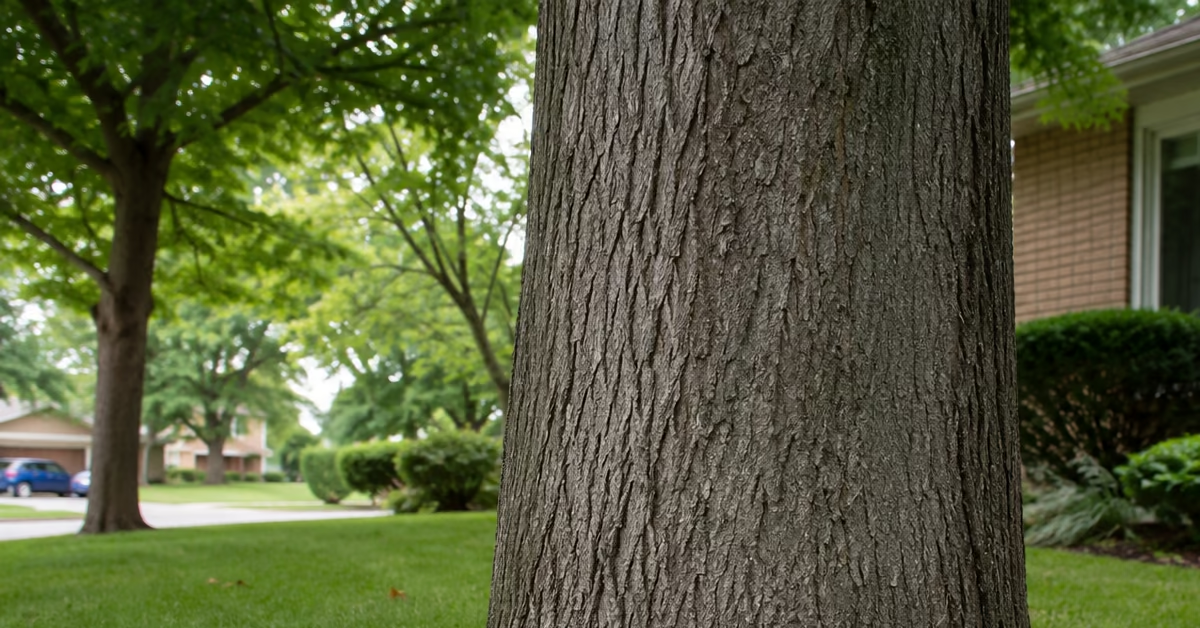
Walk to the base of your biggest maple. Does the trunk widen and flare outward where it meets the soil, like the base of a wine glass? Or does it go straight in like a telephone pole? If it’s the telephone pole, your tree may be strangling itself, and the process has likely been underway for a decade.
What a Girdling Root Actually Does
As both trunk and root thicken each year, a crossing root presses into the trunk like a tightening belt, crushing the tissue just under the bark that carries water up and sugars down. How girdling affects tree health is well documented: sever that flow around the full circumference and the tree dies. A girdling root does the same thing in slow motion.
Girdling Root Facts Every Homeowner Should Know
- Decline typically takes 10 to 20 years to become visible in the canopy.
- A girdling root compressing a third of the trunk’s circumference can starve a matching share of the canopy.
- Most affected local trees were planted 30 to 50 years ago.
- Treated early, trees usually regain canopy density within 2 to 4 growing seasons.
- Correction costs a few hundred dollars. Removing and replacing a mature tree costs thousands.
Why Livonia and Farmington Hills See So Much of It
Heavy clay soil. Roots that hit our compacted clay tend to turn and circle rather than push outward, and a circling root becomes a girdling root.
How our neighborhoods were planted. Subdivisions built from the 1960s through the 1990s used container and balled-and-burlapped stock, often planted too deep with circling roots uncorrected. The default street trees of that era, Norway maple, red maple, and linden, are also the species most prone to girdling. The mistake was made decades ago. The bill is coming due now.
The Five Signs, From the Ground Up
| Sign | What You See | What It Means |
| No root flare | Trunk enters soil straight | Flare buried or compressed; inspect below grade |
| Flat trunk side | Concave or pinched section at the base | Girdling root directly beneath that spot |
| Early fall color | One section turns weeks before the rest | Vascular stress on that side of the trunk |
| Thinning canopy | Smaller leaves, sparse foliage year over year | Restricted water and nutrient flow |
| One-sided dieback | Dead twigs and branches on one side | Girdle starving the matching side of the canopy |
A note on sign three: a maple turning red in late August isn’t getting a head start on autumn. It’s stressed. When early color appears on the same section every year, that section is being starved.
Common Girdling Root Problems We See in Livonia and Farmington Hills
“The most common version of this call is a 40-year-old maple that’s ‘suddenly’ declining. We excavate the base and find two or three girdling roots, one of them compressing a third of the trunk’s circumference, hidden under inches of soil and fresh mulch.”
Two homeowner habits make it worse. Mulch volcanoes, mulch piled against the trunk, hide the root flare and encourage new roots to circle the stem inside the mulch. Grade changes, soil added during patio or driveway projects, bury the flare the same way. If you can’t see the flare, nobody can read the signs.
There’s a safety angle too. Severely girdled trunks are structurally weak at the base; we’ve removed maples that snapped at the girdle point in windstorms. The International Society of Arboriculture treats root collar examination as standard practice in mature tree inspection, and the professional arboriculture best practices it publishes guide every inspection our team performs. Michigan State University Extension makes the same recommendation for any mature tree showing unexplained decline.
Can You Fix Girdling Roots Yourself?
Do yourself:
- Pull mulch back so it never touches the trunk: 3 to 4 inches deep, donut-shaped.
- Gently expose a shallowly buried flare with a hand trowel.
- Photograph the base yearly. Decline is gradual; photos make it visible.
Don’t do yourself:
- Don’t cut a girdling root with an axe or saw. Wrong cuts, or too much in one season, can shock or destabilize the tree.
- Don’t add soil or raise grade around any mature tree.
Call a professional when the flare is deeply buried, a girdling root exceeds 2 inches across, or canopy symptoms have appeared. Proper treatment is root collar excavation: careful exposure, selective severing, and a staged plan for multiple roots. The girdling root identification and prevention guidance from MSU Extension is clear that timing and dose matter. This is corrective surgery, not demolition.
If more than half the canopy is dead or the base is structurally compromised, tree removal before storm season is the safer call, with stump grinding to finish the site cleanly. In tight quarters between houses, crane-assisted removal protects everything around the tree.
Common Questions About Girdling Roots
Can a tree recover from girdling roots?
Usually, yes, if treated before the girdle crushes a large share of the trunk’s circumference. Trees corrected early typically regain canopy density within 2 to 4 growing seasons.
How much does girdling root correction cost?
Root collar excavation typically runs a few hundred dollars depending on tree size and burial depth, far less than removing and replacing a mature tree.
Which trees get girdling roots most often?
Norway maple, red maple, sugar maple, linden, and magnolia top the list in southeast Michigan. Oaks and hickories are less prone but not immune.
Is early fall color always a girdling root?
No. Drought, compaction, and root damage cause it too. Early color on one section, combined with a missing root flare, points strongly to girdling.
What happens if I leave a girdling root alone?
It never loosens; the pressure only grows. The outcome is decline and eventual failure. The only question is how many years it takes.
Check Your Trees Before the Damage Is Done
Girdling roots do their work silently, below the mulch line, years before the canopy shows it. The trees most at risk in Livonia and Farmington Hills are the mature maples and lindens planted when these neighborhoods were built, which means the clock has been running for decades.
The inspection takes minutes: look for the flare, check for flat spots, and compare the canopy side to side. If anything looks off, or if you simply can’t see the root flare at all, get a professional opinion before the next storm season tests the trunk.
Wondering what’s under your maple? Contact us for an inspection anywhere in Livonia or Farmington Hills, or request a free estimate online.