May 9, 2026
Key Takeaways:
- Weight Dynamics: Ice can increase the weight of a branch by 30 times, leading to catastrophic failures in weak joints.
- Species Sensitivity: Deciduous trees with tight V-shaped crotches and multi-stemmed evergreens are at the highest risk.
- The Widow-Maker Effect: Snow often hides partial fractures that become deadly falling hazards during the spring thaw.
- Physiological Stress: Beyond breakage, winter weather causes sunscald and salt damage that weakens a tree’s immune system.
- Mitigation Matters: Proper dormant pruning is the best defense against winter load failures in Southeast Michigan.
There is a specific kind of quiet that settles over Southeast Michigan after a heavy snowfall. In places like Farmington Hills and West Bloomfield, we look out at the pristine white landscape and admire the beauty of the season. But for the trees in our yards, that beauty represents a massive physical burden. A single inch of ice accumulation can add hundreds or even thousands of pounds of pressure to a mature canopy. When you combine that weight with the gusting winds that whip across Oakland and Livingston counties, you have a recipe for structural failure.
Understanding how snow and ice damage trees is essential for any homeowner in the Detroit metro area. We live in a region where the clash of the masses’ weather is common, where warm moisture from the south meets arctic air from the north. This often results in heavy wet snow and freezing rain. Unlike light, fluffy powder, this moisture sticks to branches like wet concrete. If your trees haven’t been maintained, they are essentially standing in a state of high alert, waiting for the one limb that simply cannot hold another ounce.
The Physics of Ice Accumulation
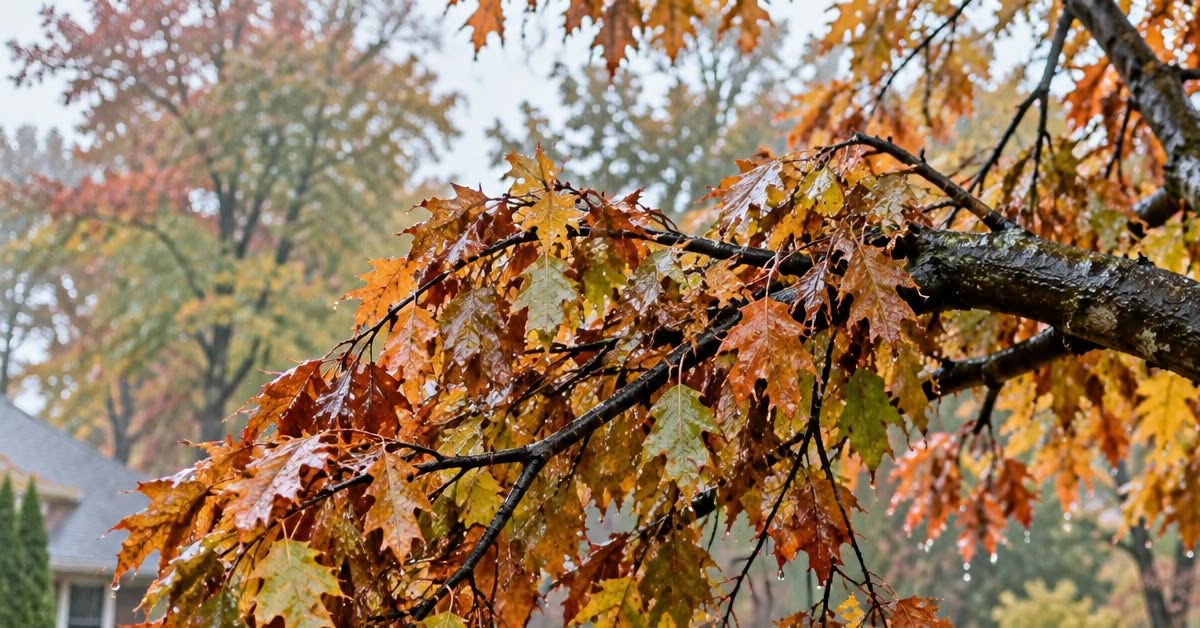
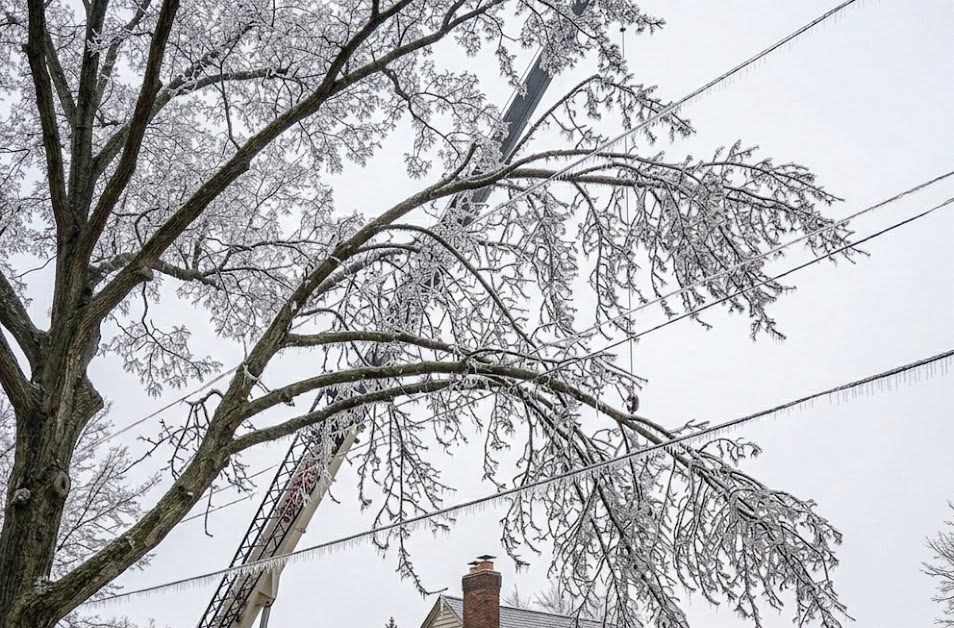
Ice is deceptively heavy. It is much denser than snow, and it coats every surface evenly, including every tiny twig and bud. This creates a lever effect. The further out from the trunk the ice accumulates, the more torque it applies to the branch union. In Southeast Michigan, ice storms are particularly dangerous because they often follow a period of rain that has already saturated the bark.
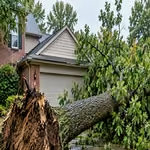
When ice builds up to a thickness of just half an inch, it can increase the weight of a branch by 30 times its normal mass. Trees are biological structures designed to handle vertical loads, like their own weight, but they struggle with the lateral forces and extreme weight of ice. This is when we see catastrophic failure. A branch doesn’t just sag, it snaps. If the tree has a pre-existing included bark condition or a V-shaped crotch, the entire tree can split down the middle, leaving a jagged, dangerous mess that threatens your home or power lines.
Heavy Snow and Widow-Makers
While ice is the most dramatic offender, heavy wet snow is the most frequent cause of damage in Livonia and Novi. Evergreen trees like White Pines and Arborvitae are especially vulnerable because their needles act like broad paddles that catch and hold the snow. This is why you often see evergreens splayed open like an umbrella after a big storm.
One of the most dangerous results of a heavy snow load is the creation of widow-makers. These are large limbs that have partially fractured or snapped completely, but are still tangled in the lower canopy. They are often hidden by the very snow that broke them. When the snow melts or the wind picks up, these limbs can fall without warning. In the spring, we often find these hazards during our initial walkthroughs, branches that look fine from a distance but are actually detached and resting on a single twig.
Frost Cracks and Sunscald
Not all winter damage is caused by weight. Some of the most long-lasting injuries to Southeast Michigan trees come from temperature fluctuations. We are all familiar with those rare January days in Royal Oak or Birmingham where the sun comes out, and the temperature briefly hits 40 degrees, only to drop back to zero at night.
This causes sunscald. The sun warms the bark on the south-southwest side of the tree, waking up the living tissue beneath. When the sun goes down and the temperature drops rapidly, that tissue freezes and dies before it can go back into dormancy. This results in long vertical cracks in the bark known as frost cracks. These openings are like an unstitched wound. They allow fungi and wood-boring insects to enter the tree in the spring, leading to internal decay that weakens the tree for years to come.
The Impact of Road Salt on Root Health
In Southeast Michigan, we use a massive amount of salt to keep our roads and sidewalks safe. Whether you are in Northville or Plymouth, your trees are likely dealing with the runoff. Salt is a desiccant; it literally sucks the moisture out of the soil and the roots.
When snow and ice melt, the salt-laden water carries sodium and chloride deep into the root zone. This interferes with the tree’s ability to take up essential nutrients like potassium and magnesium. In the spring, you might notice that the trees near the street have scorched leaves or stunted growth. This isn’t just a cosmetic issue. Salt damage weakens the tree’s overall health, making it less able to heal from the physical breaks caused by the weight of the snow itself.
Species Most at Risk in Southeast Michigan
Not all trees handle a Michigan winter the same way. Species with brittle wood or poor branch architecture are the first to fail when the ice moves in.
- Silver Maples: These are extremely common in older neighborhoods like Detroit and Southfield. They grow fast but have very brittle wood and often develop multiple trunks that split easily under ice.
- Bradford Pears: These are notorious for self-destructing in winter. Their branches all grow from a single point, creating a weak center that cannot handle heavy snow.
- Arborvitae: While great for privacy, their multi-stemmed nature means they often flop open under snow. If they aren’t tied or pruned correctly, they may never return to their original shape.
- Willows: Their long, thin branches are perfect targets for ice accumulation, and they are among the first to drop limbs during a storm.
Identifying Internal Decay Before the Storm
The trees that fall during a Southeast Michigan winter are often those that were already hollow or suffering from internal rot. Fungus or mushrooms growing at the base of a tree in the fall is a major red flag. It indicates that the root system or the heartwood is decaying. When a tree is hollow, it loses its structural flexibility. Instead of bending with the weight of the ice, it shatters. This is why hazard mitigation is such a core part of what we do. By identifying these issues in the late summer or fall, we can remove a dangerous tree before the first snowflake ever touches the ground.
When the heavy snows of Southeast Michigan begin to pile up, you need a team that understands the specific pressures our local landscapes face. Clean Cut Tree Experts has been a trusted partner for homeowners in Farmington Hills, Livonia, and Novi for over 25 years. Our founder, Jeremy Clarke, brings a wealth of knowledge in managing both large hazardous removals and delicate structural pruning. We don’t just react to storms; we help you prepare for them with a holistic approach that focuses on the long-term health and aesthetics of your property. Our team utilizes professional equipment, including two cranes and bucket trucks, to safely handle dangerous trees that are too risky for traditional methods. Clean Cut Tree Experts takes immense pride in our respectful approach to your property. Our climbers work meticulously to avoid damaging your well-maintained lawn.
As a family-owned business recently awarded the Angie’s List Super Service Award for the seventh year in a row, we offer honest, competitive pricing and a no-money-upfront policy on insurance claims. Whether you need a senior discount or a 24/7 emergency response after a midnight ice storm, Clean Cut Tree Experts is here to protect your home and your family. Call Clean Cut Tree Experts today at (734) 290 -3370 for a free estimate.
Frequently Asked Questions by the Homeowners in Michigan
How can I tell if a branch is about to break under snow in Southeast Michigan?
If a limb is sagging significantly lower than its neighbors or if you hear a popping or cracking sound, it is under extreme stress. Never stand under a snow-laden tree to inspect it. If the branch is over a structure or power line, it is a critical hazard.
Should I shake the snow off my evergreen trees?
You should only gently brush the snow off with an upward motion. Never shake the branches violently or use a heavy shovel to beat the snow off. In freezing temperatures, wood is very brittle, and you can actually snap the branches you are trying to save.
What is the best way to prevent winter tree damage in Michigan?
Dormant pruning in the late fall is the most effective prevention. By thinning the canopy and removing crossing branches, you reduce the surface area that catches snow and ice. This allows the wind to move through the tree rather than pushing against it.
Can a tree survive a major split in the trunk?
It depends on the depth and location. Some splits can be saved through professional cabling and bracing, which uses high-strength hardware to hold the tree together while it heals. However, if the split goes deep into the root, flare removal is usually the only safe option.
Why does Clean Cut Tree Experts use a crane for winter removals?
Ice-covered trees are incredibly unpredictable. A crane allows us to lift heavy sections vertically and away from your house without them falling onto your roof or lawn. It is the safest and most efficient way to handle storm damage cleanup.
What should I do if a tree falls on a power line in Michigan?
Do not go near the tree. Call your local utility company, like DTE or Consumers Energy, immediately. Once the power company has cleared the lines and deemed the area safe, Clean Cut Tree Experts can come in to remove the debris.
Is winter a good time for tree removal in Michigan?
Actually yes. The ground is often frozen, which means our equipment is less likely to leave ruts in your lawn. Additionally, because the trees are dormant, we can clearly see the structural skeleton of the canopy.
How do I handle an insurance claim for a fallen tree?
If a tree falls on a covered structure, Clean Cut Tree Experts can work directly with your insurance provider. We handle the billing directly, so you don’t have to pay anything up front, making the recovery process much easier for you.
Summary Checklist: Winter Tree Hazards
| Hazard Type | Visual Signs | Risk Level |
|---|---|---|
| Ice loading | Branches sagging significantly under heavy ice accumulation | Critical, immediate branch or structural failure risk |
| Included bark | Deep V-shaped branch unions with visible seams or compressed bark | High, elevated splitting and storm failure risk |
| Snow accumulation | Evergreens bent outward, flattened, or showing abnormal branch spread | Moderate, may cause permanent structural deformation |
| Widow-makers | Broken or snapped branches hanging in the canopy | High, dangerous falling hazard during thaw or wind events |
| Sunscald | Long vertical bark cracks, often on the south or southwest side of the trunk | Moderate, may contribute to long-term tree stress and decline |
Final Advice
Homeowners must conduct a visual inspection of their trees before the first major snow event in November to identify pre-existing cracks or weak branch unions. To ensure the safety of your property, prioritizing the removal of dead or decaying wood is a critical step in preventing winter failures. Attention should be paid to evergreens located near walkways, as their tendency to hold heavy snow can create unexpected blockages or hazards. It is advisable to avoid planting brittle species like Silver Maples or Bradford Pears near power lines or structural foundations. Supplemental watering in the late fall is viewed as a strategic necessity, as well-hydrated trees are more flexible and less likely to shatter under ice loads.
Consulting with a professional allows for the precise installation of cables or braces that can reinforce a tree’s natural structure. Maintaining a consistent pruning schedule remains the most effective way to reduce the sail area of a canopy and minimize wind resistance during blizzards. Ultimately, the choice to invest in preventative tree care is considered a safeguard that protects both your home’s value and your family’s safety throughout the harsh Michigan winter.