May 8, 2026
Key Takeaways:
- Safety First: Always assume downed power lines are energized and stay at least 30 feet away from any hanging limbs.
- Assess Structural Integrity: Look for hairline trunk splits and leaning that suggest the root system has been compromised.
- Document for Insurance: Take clear photos of any tree damage that has impacted your home, vehicles, or fences before moving debris.
- Avoid DIY Hazards: Do not attempt to use a chainsaw on tensioned wood or limbs tangled in utility lines.
- Hire Licensed Professionals: Ensure your tree service uses specialized equipment like cranes for safe extraction from structures.
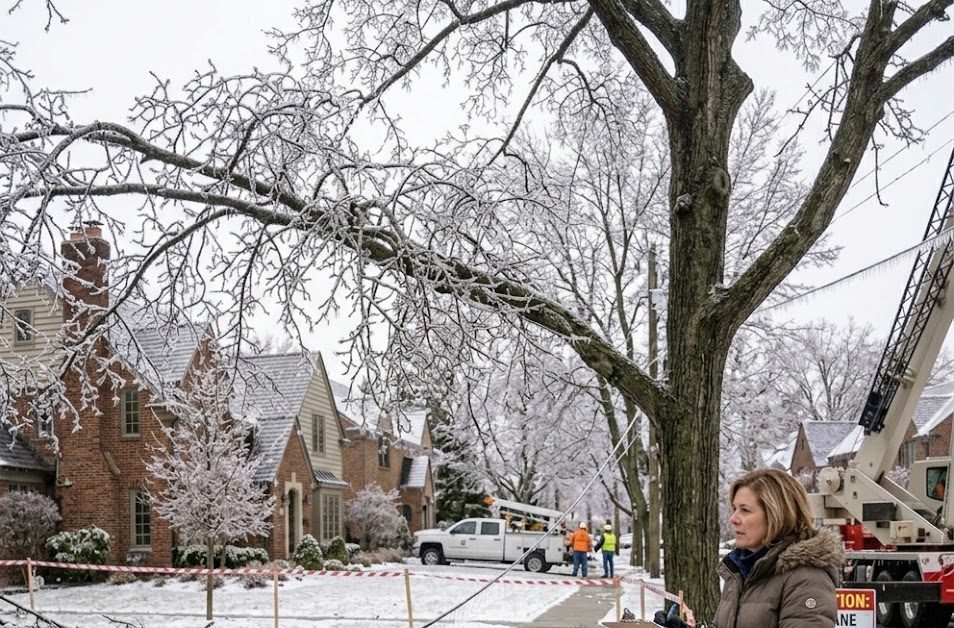
There is a surreal, almost haunting beauty that follows an ice storm in places like Farmington Hills, Birmingham, and Novi. Every twig and needle is encased in a crystal shell, turning the landscape into a glass forest. But for property owners, that beauty is quickly replaced by the sound of snapping timber and the realization that their landscape has just undergone a violent physical transformation.
When the freezing rain stops and the sun begins to peek through, the immediate instinct is to rush outside and begin cleaning up. However, the period immediately following an ice storm is the most dangerous time for homeowners. The ice that brought the branches down is still melting, making surfaces slick and making remaining hangers unpredictable. Knowing exactly what to do and what not to do can be the difference between a successful recovery and a tragic accident.
Establish a Safety Perimeter Immediately
The very first thing any property owner in Southeast Michigan must do after an ice storm is look up and then look down. The weight of ice often brings down utility lines along with the branches. Because ice is a conductor, a line touching a fence or a wet lawn can energize a massive area. You must treat every downed wire as a live, lethal threat.
Stay at least 30 feet away from any fallen lines and immediately report them to DTE or your local utility provider. Furthermore, do not walk under the canopy of trees that are still heavily laden with ice. As the ice melts, it shifts the center of gravity of the branches, which can cause delayed failures. A limb that survived the height of the storm may snap two hours later as the weight redistributes. Keep children and pets indoors until a full perimeter sweep has been conducted from a safe distance.
Performing a Preliminary Damage Assessment
Once you have confirmed that there are no immediate electrical hazards, you can begin to evaluate the health of your trees. Not all storm damage is obvious. While a fallen limb is easy to spot, structural cracks in the trunk or root heaving are more subtle and often more dangerous.
Walk your property and look for up-arching soil at the base of your large Maples or Oaks. This is a sign that the root system has partially failed under the lateral pressure of the wind and ice. If the tree is leaning more than it was before the storm, it is no longer structurally sound. You should also look for widow-maker limbs that have snapped but are currently being cradled by lower branches. These require professional rigging to remove safely without damaging your roof or landscaping.
The Complexity of Tensioned Wood
For those who own a chainsaw, the temptation to start bucking up fallen logs is high. However, storm-damaged wood is rarely straightforward. When a tree falls or a limb snaps but remains attached, it often holds stored energy. This is known as tensioned wood or spring poles.
When you make a cut into a branch that is under tension, it can kick back or spring with enough force to cause severe injury or death. In an ice storm scenario, branches are often twisted and pinned under other debris, making it nearly impossible for an untrained eye to determine which way the wood will move when released. This is why storm cleanup is significantly more hazardous than standard tree removal. Professional crews are trained in tension and compression cutting techniques to neutralize these forces before they become dangerous.
Documenting Damage for Insurance Purposes
In Michigan, many homeowners’ insurance policies cover the removal of trees that have fallen on a covered structure, such as your house, garage, or fence. Before any work begins, it is vital to document the scene thoroughly. Take high-resolution photos from multiple angles, showing exactly how the tree is resting on the structure.
Do not attempt to move the tree yourself, as this can actually cause more damage to your shingles or siding and potentially complicate your insurance claim. Most reputable tree services in Oakland and Livingston counties are experienced in working with insurance adjusters. They can provide the necessary documentation and offer no money up front billing options that allow the work to proceed quickly while the claim is being processed.
Assessing the Tree’s Future: To Save or Remove?
After the immediate danger has passed, the question becomes: can the tree be saved? A tree that has lost more than 50% of its canopy is generally considered a loss, as it will struggle to produce enough energy to heal and grow. However, if the main leader (the central trunk) is intact and the damage is limited to smaller lateral branches, a professional arborist may be able to perform restorative pruning.
Jagged, torn bark from a storm break is a magnet for pests and disease. A professional will make clean, collar-focused cuts that allow the tree to naturally compartmentalize the wound. If the tree has a significant vertical split in the trunk, it is usually a candidate for removal. Trying to save a severely split tree is often a gamble that results in the tree falling during the next minor windstorm.
The Role of Specialized Equipment in Storm Recovery
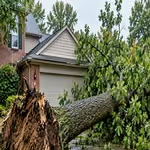
Storm cleanup in tight residential areas like Livonia or Royal Oak often requires more than just a truck and a saw. When a massive tree is resting on a roof, traditional felling is impossible. This is where crane-assisted removal becomes the only safe choice.
A crane can lift the weight of the tree vertically off your home, preventing the dragging effect that often destroys gutters and rooflines. Furthermore, bucket trucks allow crews to reach high-altitude hangers that are too unstable for a climber to access. Using the right mechanical advantage not only speeds up the recovery process but also ensures that no further damage is done to your property during the cleanup phase.
When an ice storm leaves your property in a state of chaos, you need a team that acts quickly and works with surgical precision. Clean Cut Tree Experts has been a trusted leader in Southeast Michigan storm response for over 25 years. Led by founder Jeremy Clarke, our family-owned business understands the urgency of hazardous tree situations in communities like Farmington Hills, Novi, and Southfield. We are fully equipped with two cranes and multiple bucket trucks, allowing us to safely lift massive debris off your home without causing further structural damage. Our crews are trained in complex rigging and the management of tensioned wood, ensuring that every cut is calculated and controlled.
Clean Cut Tree Experts takes immense pride in our no money up front policy for insurance billing, taking the financial stress out of emergency repairs. As a seven-time winner of the Angie’s List Super Service Award, we stand by our word to provide honest, competitive pricing and a meticulous cleanup that leaves your yard looking better than we found it. Whether you are a senior citizen in need of our special discount or a homeowner facing a 2 AM emergency, trust Clean Cut Tree Experts to restore safety and beauty to your landscape with professional, licensed, and insured care.
Frequently Asked Questions by Homeowners in Michigan
Does insurance always pay for tree removal after a storm?
Usually, insurance covers the removal of a tree only if it has fallen on and damaged a covered structure like your house, garage, or fence. If a tree falls in the middle of your yard without hitting anything, it is often considered a debris removal issue that may not be covered, though policies vary.
What should I do if a tree is leaning toward my house after an ice storm?
A leaning tree after a storm is an emergency. It indicates that the root system has been compromised. You should evacuate the area of the house the tree is leaning toward and call a professional for an immediate hazardous assessment.
Can I use a ladder to reach broken branches in Michigan?
No. You should never use a ladder to perform tree work, especially after an ice storm. The ground is often unstable, and the branches you are reaching for are unpredictable. Most fatal tree accidents involve homeowners on ladders.
How long does it take for a tree to recover from ice damage?
A tree’s recovery depends on its species and overall health. It may take several growing seasons for a tree to fill in the holes left by broken branches. Regular deep-root fertilization and proper pruning can help accelerate this recovery process.
Why is crane-assisted removal better for storm damage?
Cranes provide a zero-impact solution. Instead of cutting a tree and letting it fall onto your lawn or house, we lift it vertically. This is the only way to safely remove a tree that is physically resting on a building.
What is included in bark, and why does it matter in a storm?
Included bark occurs when two trunks grow too close together, creating a weak seam instead of a strong wood union. These are the first points to fail during an ice storm. If your tree has a V-shaped crotch, it likely has included bark.
Should I fertilize my trees immediately after a storm?
It is advisable to wait until the following spring. You want the tree to focus on sealing its wounds during the winter. Once the growing season begins, a specialized fertilizer can provide the nutrients needed for new growth.
Are your estimates free for storm damage?
Yes. Clean Cut Tree Experts provides free, no-obligation estimates. We will walk your property with you, identify the hazards, and provide a transparent plan for safe removal or restoration.
Summary Checklist: Post-Ice Storm Action Plan
| Action Item | Priority | Purpose |
|---|---|---|
| Check for nearby power lines | Critical | Prevent electrocution hazards and contact the utility provider immediately if lines are involved |
| Establish a safety drop zone | High | Keep people, pets, and vehicles away from unstable branches or potential impact areas |
| Photograph all visible damage | High | Create documentation for insurance claims, contractors, and emergency response records |
| Inspect the root flare and ground area | Moderate | Look for soil heaving, exposed roots, or signs of tree instability after storm damage |
| Contact a professional tree crew | High | Ensure safe removal using proper equipment for hazardous or structure-related tree failures |
Final Advice
Property owners must refrain from any DIY cleanup involving large limbs or trees that are leaning against other structures. To ensure the long-term safety of your home, prioritizing a professional assessment of the tree’s remaining structural skeleton remains the most important step after the ice melts. Attention should be paid to the secondary growth that will occur in the spring, as sucker growth at the site of a storm break is often weak and needs to be managed through corrective pruning.
It is important to maintain a safe distance from any tree showing visible trunk splits, as these can fail without any additional wind or ice. Supplemental deep-root feeding in the spring is viewed as a strategic necessity to help the tree recover the energy lost during the storm. Consulting with a crew that operates its own cranes ensures that the extraction process does not lead to secondary damage to your roof or foundation. Maintaining a clear record of the damage and the repairs performed is considered a professional best practice for future property valuations. Ultimately, the choice to act proactively after an ice storm is viewed as an investment in both the safety of your family and the resilience of your Southeast Michigan landscape.