August 18, 2026
Key Takeaways
- The most dangerous trees are rarely the ones that look the most obviously dead.
- Root and trunk issues cause the majority of the serious tree failures we’ve responded to over the years.
- Certain species common in Farmington are more prone to specific structural weaknesses.
- A tree’s history, including past construction, grading, or storm events, tells us as much as its current appearance.
- Mushrooms, cavities, and cracks are three of the most reliable warning signs we look for.
- Regular inspection catches problems years before they become emergencies.
Over more than two decades of climbing, cutting, and inspecting trees throughout Farmington Hills and the surrounding communities, certain patterns show up again and again. Some of them surprised us early in our careers. Others confirmed what we already suspected but hadn’t yet seen play out enough times to be certain. What follows is less a textbook list of hazard signs and more a summary of what repeated, real-world experience across thousands of Southeast Michigan trees has actually taught us.
The Most Dangerous Trees Rarely Look the Worst
If there’s one lesson that surprises homeowners more than any other, it’s this: the trees that fail catastrophically are frequently not the ones that look obviously sick. A tree with thin, sparse foliage and visible dead wood is at least announcing that something is wrong. The trees that concern us most are often the ones that look green, full, and perfectly normal from the ground while hiding serious internal decay or root damage that only becomes apparent on close inspection, or after it’s too late.
This is part of why a visual assessment from the driveway rarely tells the whole story. Clean Cut Tree Experts walked up to trees homeowners described as “totally healthy” and found significant cavities at the base, hidden by bark that had grown over the opening, or root damage from construction work done years earlier that the homeowner had forgotten about entirely.
Root and Trunk Problems Cause Far More Failures Than Branch Problems
If we have to rank the sources of the tree failures and near-failures we have responded to over the years, they are as follows –
- Root and trunk defects are the leading causes of tree failure. Based on our experience, problems involving the root system and main trunk account for far more tree failures and near-failures than branch-related issues alone.
- Branch loss does not necessarily compromise tree stability: A healthy tree can often lose a large branch and remain structurally sound, whereas damage to the roots or trunk significantly increases the risk of failure.
- Structural weaknesses cannot be corrected through canopy pruning: When the root plate is compromised or the trunk has developed a major split, trimming branches does not address the underlying structural problem.
- The foundation of the tree determines its stability: The most critical failure point is often below or near the base of the tree rather than in the canopy.
- Construction activities frequently damage tree roots: Driveway replacements, utility trenching, home additions, and grading projects can sever or compact roots, often without immediate visible signs.
- Root damage may remain hidden for years: Trees can appear healthy long after construction-related root injuries occur, making these issues easy to overlook.
- Visible decline is often delayed: By the time canopy thinning, dieback, or other symptoms become apparent, the underlying root damage has usually been progressing for an extended period.
Certain Species Show Up Again and Again in Our Hazard Calls
Over the years, certain species have earned a level of extra scrutiny in our assessments, not because every individual tree of that species is dangerous, but because these species have structural tendencies that make hazards more likely under the right conditions.
- Silver maples are one of the most common calls we get for hazard assessment in Farmington Hills. They grow fast, which residents often like, but that speed comes with weaker wood and a higher likelihood of large limb failure, especially in older specimens with substantial canopy weight.
- Bradford pears, though less common in older Farmington neighborhoods, have a well-documented tendency toward included bark and weak branch unions that make them prone to splitting apart, sometimes with very little warning.
- Norway maples, common as street and yard trees throughout the area, can develop girdling roots that slowly strangle the tree’s own root system over decades, weakening its anchorage without any obvious above-ground symptom until the tree eventually leans or fails.
None of this means these species should automatically be removed. It means we pay closer attention to them. Clean Cut Tree Experts encourage homeowners with these species on their property to do the same, particularly as the trees age past 30 or 40 years.
The Three Signs We Never Ignore
Across thousands of assessments, 3 specific signs have proven to be some of the most reliable indicators of a genuinely hazardous tree, regardless of species or overall appearance.
- Mushrooms or fungal conks growing directly from the trunk or from the root flare at the base of the tree are one of the clearest signals of internal decay. Fungi don’t grow on healthy, solid wood, they grow on wood that’s already breaking down. Finding fungal growth at the base of a tree is one of the fastest ways to move a routine trim request into a full hazard assessment.
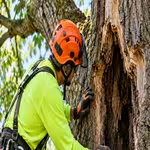
- Cavities, whether visible openings in the trunk or hollow-sounding areas detected by tapping the wood, indicate that a significant portion of the tree’s structural wood has already been lost to decay. A tree can survive with some degree of internal cavity, since a tree’s structural strength comes primarily from its outer wood layers, not the center, but the extent and location of a cavity relative to the tree’s overall diameter determines how much risk it actually represents.
- Cracks in the trunk or at major branch unions, especially cracks that appear to be new or actively widening, suggest the tree’s structural integrity has already been compromised in a way that’s likely to worsen under wind load or added weight from ice or heavy, wet snow, both of which are realities of a Michigan winter.
A Tree’s History Matters as Much as Its Current Appearance
One of the more subtle lessons two decades of work has taught us is that we can’t fully assess a tree’s risk without understanding what’s happening around it.
- Has there been recent construction or excavation nearby?
- Was there a significant storm in the past few years that might have caused hidden root or trunk damage?
- Has the grade of the yard changed, burying the root flare under added soil?
- Has the tree recently been over-pruned or topped by a previous, less careful contractor?
These historical factors often explain problems that wouldn’t otherwise make sense. A seemingly healthy tree that suddenly develops a lean, or a tree that starts declining years after a driveway was repaved nearby, both make far more sense once the property’s history is factored into the assessment.
Why Regular Inspection Beats Reactive Response
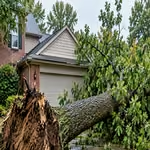
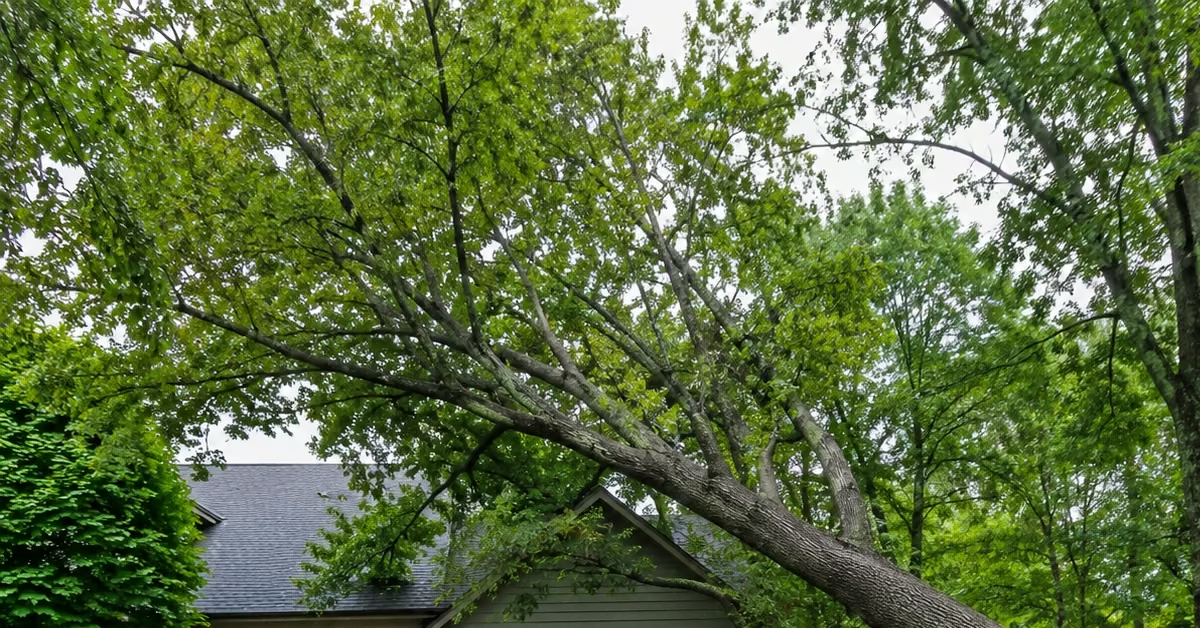
The single biggest difference between the tree failures we’ve responded to as true emergencies and the hazards we’ve caught and addressed calmly is timing. A tree inspected periodically, particularly mature trees over 30 years old or trees that have experienced any of the stressors above, gives us the chance to catch developing problems years before they become a genuine emergency. A tree that’s never been looked at until it’s leaning over a roof leaves far fewer good options.
Clean Cut Tree Experts encourage Farmington Hills homeowners with mature trees, especially species like silver maple, Norway maple, and other trees with known structural tendencies, to have a professional assessment done periodically rather than waiting for a visible problem to prompt the call.
Clean Cut Tree Experts bring more than 25 years of combined, hands-on experience assessing and managing exactly the kinds of hazards described above. We have built our reputation on honest assessments, not just because it’s good business, but because we’ve seen what happens when a hazardous tree goes unaddressed, and we take that responsibility seriously.
Frequently Asked Questions About Dangerous Trees in Farmington
How can I tell if a tree on my property is actually dangerous?
Look for mushrooms or fungal growth at the base, visible cavities or hollow-sounding trunk areas, new or widening cracks, and any recent change in lean. If you notice any of these, a professional assessment is worth scheduling.
Are certain tree species more dangerous than others in Farmington Hills, Michigan?
Some species, including silver maple, Bradford pear, and Norway maple, have structural tendencies that make hazards more likely as they age, though individual tree health always matters more than species alone.
Can construction work years ago still be causing problems for my tree today?
Yes. Root damage from past construction, trenching, or grading often takes years to show visible symptoms above ground, even though the underlying damage may have been progressing the whole time.
How often should mature trees be professionally inspected?
For mature trees, particularly those over 30 years old or with known risk factors, a periodic assessment every few years, or sooner after any major storm or nearby construction, is a reasonable standard.
Do Clean Cut Tree Experts offer hazard assessments in Farmington Hills?
Yes, hazard assessment is a core part of what we do, and we offer free estimates for homeowners who want a professional opinion on a tree’s condition.
Summary Checklist: Spotting a Dangerous Tree
| Step | Key Consideration | Action Item |
| Base Inspection | Check for mushrooms or fungal growth | Treat any fungal growth at the base as a priority flag |
| Trunk Check | Look for cavities and cracks | Have any hollow-sounding areas professionally assessed |
| Species Awareness | Some species carry more structural risk | Give extra attention to silver maple, Bradford pear, Norway maple |
| Property History | Consider past construction or storms | Factor recent excavation or grading into risk assessment |
| Lean and Root Flare | Watch for new lean or buried root flare | Note any changes from previous years |
| Ongoing Monitoring | Don’t wait for a visible emergency | Schedule periodic inspections for mature trees |
Final Advice
Over two decades of experience in professional tree care have shown us that the trees requiring the most attention are not always those that appear the most concerning. Subtle indicators, such as fungal growth at the base, hairline cracks, or a slight lean, often signal more significant structural issues than highly visible but relatively harmless conditions, such as dead branches in the upper canopy of an otherwise healthy tree.
If you have a mature tree on your Farmington Hills property and it has not been professionally assessed in recent years, scheduling an inspection is a prudent step. A thorough evaluation can identify hidden risks, protect your property, and help prevent costly damage before Michigan’s next major storm puts the tree to the test. Call Clean Cut Tree Experts at (734) 290-3370 for a free hazard assessment.